


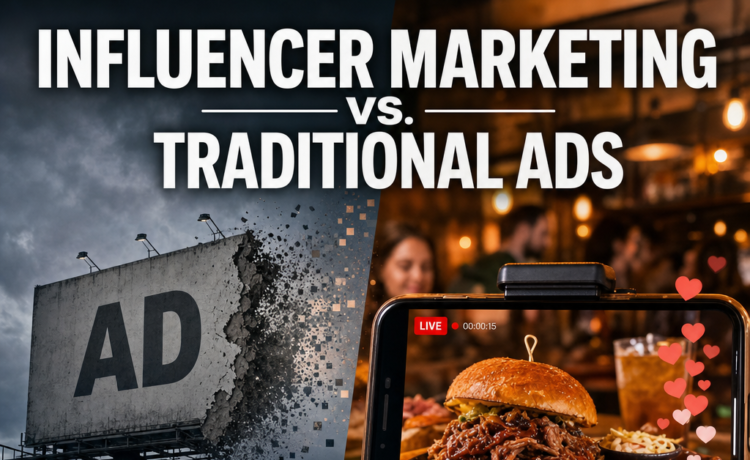
Short answer: Influencer marketing is overtaking traditional ad buying because it earns trust instead of renting attention, produces searchable content that compounds in value for months or years, costs a fraction of a media buy, delivers real foot traffic instead of vague impressions, and targets hyper-local audiences that billboards and TV spots can’t reach. For restaurants in Georgia, that shift is the difference between paying thousands for maybe 20 walk-ins and paying a fraction to fill a room with real paying customers.
For decades, “advertising” meant buying space: a billboard on I-75, a 30-second radio spot, a quarter-page in the local paper, or a boosted post you forget about the moment the budget runs dry. You paid, you crossed your fingers, and you hoped the right person happened to be looking. That model is breaking down fast — and influencer and creator marketing is what’s breaking it. Below are the five biggest reasons the old playbook is losing, and what it means for restaurant owners specifically.
1. Trust beats interruption
Traditional ad buying is built on interruption. It stops you mid-song, mid-show, or mid-scroll to shout a message you didn’t ask for. Audiences have learned to tune it out — ad blockers, “skip ad” reflexes, and DVR fast-forwarding all exist because people actively avoid paid ads. When a message clearly costs money to broadcast, viewers instinctively discount it.
Influencer marketing flips that dynamic. When a local food creator walks into your restaurant, orders your signature dish, and reacts honestly on camera, their audience experiences it as a recommendation from someone they already follow and trust — not as an advertisement. That perceived authenticity is why a single creator video often outperforms a far more expensive ad campaign. People don’t share billboards with their friends. They share the video of the creator biting into your brisket.
The gap comes down to social proof. A diner deciding where to spend their money wants evidence that other real people had a good experience, and a creator’s honest reaction supplies exactly that. A polished ad, by contrast, only proves you had the budget to make an ad. In a world where a potential customer can pull up dozens of options on their phone in seconds, the recommendation that feels like a friend’s tip will win over the one that feels like a sales pitch nearly every time.
2. Creator content is searchable and compounds over time
This is the reason most restaurant owners underestimate — and it’s the one that matters most for long-term value. A traditional ad is a candle: it burns only as long as you keep paying. The moment your media budget stops, the impressions stop. A well-made creator video is closer to a solar panel: it keeps generating attention long after the initial spend, because platforms like YouTube, TikTok, and Instagram are also search engines. People type “best tacos near me” or “where to eat in Augusta” into those apps every single day, and evergreen video content keeps surfacing to them for months or years.
Case study: Tacocat in Augusta
Here’s a real example from our own work. While in Augusta, we recorded a promotional video for a restaurant called Tacocat. The initial release pulled in about 3,000 views — a solid result on its own. But the story didn’t end there. Roughly four months later, that same video picked up another 6,000 views, tripling its total reach without a single additional dollar spent.
Why? Because the content was searchable. As people looked up food in the Augusta area, the algorithm kept serving them the Tacocat video. That’s the compounding effect a traditional ad simply cannot deliver. A radio spot that ran four months ago is gone; the Tacocat video is still working, still being discovered, and still driving awareness. This is the powerful advantage of tools like YouTube: the content is indexed, discoverable, and grows in value over time instead of evaporating when the campaign ends.
3. The cost-to-result math no longer favors ad buying
Traditional advertising is expensive and its results are notoriously hard to measure. You can spend thousands on a print run or a broadcast package and never know how many diners actually walked in because of it. Attribution is a guessing game.
Creator marketing inverts that equation. For a fraction of a typical ad budget, you get a tangible library of assets — a professionally produced promotional video and multiple short-form clips — that you own and can reuse across every channel you have. Instead of paying for fleeting impressions, you’re paying for durable content plus measurable engagement: views, saves, shares, and comments you can actually see. When the deliverables outlive the campaign and the price tag is a fraction of a media buy, the return on investment isn’t close.
Think about what you’re actually left with after each type of spend. When a radio flight or a print run ends, you have nothing to show for it but a line item on an invoice. When a creator campaign ends, you own a promotional video and a set of shorts you can pin to your profile, embed on your website, send to a food blogger, or run as an organic post whenever business is slow. The same content can anchor a Google Business listing, greet visitors on your homepage, and live on YouTube where new diners keep finding it. One spend disappears; the other becomes a permanent part of your marketing toolkit.
| Factor | Traditional ad buying | Creator & community marketing |
|---|---|---|
| Lifespan | Ends when budget stops | Compounds for months or years |
| Trust | Discounted as “an ad” | Received as a recommendation |
| Measurability | Vague, hard to attribute | Views, shares, saves, attendance |
| Cost | Thousands per campaign | A fraction of a media buy |
| Result | Impressions | Real foot traffic |
| Targeting | Broad and wasteful | Hyper-local by nature |
4. Real foot traffic beats vague impressions
An “impression” is just a number that says an ad may have crossed someone’s screen. It doesn’t put anyone in a seat. This is where the influencer and community model wins decisively — because it can convert an online audience into people physically walking through your door.
Consider the math. We have a Meetup community of roughly 5,000 followers here in Georgia. Instead of paying thousands of dollars for a campaign that might bring 20 to 30 uncertain visitors into your restaurant, you can pay an organizer a fraction of that cost to bring a group of real, paying customers to an event at your location. One approach gambles on impressions; the other delivers a full room. For a restaurant, a booked table is worth infinitely more than a thousand people who scrolled past your name.
5. Hyper-local targeting the old channels can’t match
A billboard talks to everyone who drives past — most of whom will never eat at your restaurant. Traditional ad buying is broad by design, and that breadth is waste. You pay to reach an entire region when your actual customers live within a few miles.
Creator and community marketing is local by nature. A Georgia food creator’s audience is overwhelmingly made up of Georgia diners. A local Meetup group is, by definition, local. The people seeing the content are the exact people who can realistically visit — and modern platforms reinforce that by surfacing content to nearby users searching for somewhere to eat. You’re not casting a wide, wasteful net; you’re speaking directly to the neighborhood that fills your tables.
That local relevance also builds on itself. When neighbors see people they recognize enjoying your restaurant, and when the same content keeps appearing in local searches, your name starts to feel like part of the community rather than an outside advertiser trying to buy their attention. Word of mouth — the most powerful marketing a restaurant can have — gets a running start. A billboard can never introduce you to your neighbors the way a trusted local creator or a well-run community event can.
Why this matters even more in the age of AI search
The shift away from traditional ad buying is accelerating because of how people now discover where to eat. Diners increasingly ask AI assistants and search engines direct questions like “Where’s the best barbecue near me?” or “What’s a good spot for dinner in Augusta tonight?” Those tools answer by pulling from real content — videos, reviews, listings, and articles that mention your restaurant by name. A billboard contributes nothing to that answer. A library of searchable creator content, on the other hand, gives the algorithms something concrete to surface.
This is why the compounding, searchable nature of creator content matters so much going forward. Every video, short, and mention becomes a signal that helps you show up when a hungry customer asks a machine for a recommendation. Traditional ads were never designed for that world — they were built to shout at a broad audience and disappear. Creator content is built to be found, indexed, and recommended, which is exactly what the next decade of discovery rewards.
The bottom line for restaurant owners
Traditional ad buying isn’t dead, but its dominance is over. Trust beats interruption. Searchable content compounds while paid impressions vanish. The cost-to-result math has flipped. Real foot traffic beats vague reach. And local audiences convert better than broad ones. For a restaurant deciding where to put a limited marketing budget, creator-driven content and community events now offer more durable, more measurable, and more affordable results than a comparable media buy.
Ready to fill your restaurant with real customers?
At Georgia Foodies, we help local restaurants turn attention into diners with promotional videos, short-form content, and community events that bring paying customers through your door. If you want to see what creator marketing can do for your restaurant — and get our current promotions and rates — contact us here. Let’s build something that keeps working long after a traditional ad would have gone dark.
Frequently asked questions
Is influencer marketing better than traditional advertising for restaurants?
For most local restaurants, yes. Influencer and creator marketing earns trust, produces searchable content that keeps generating views over time, costs far less than a comparable media buy, and drives real foot traffic instead of unmeasurable impressions. Traditional ads still have niche uses, but for turning a limited budget into actual diners, creator content and community events typically win.
Why does creator content keep getting views after it’s posted?
Because platforms like YouTube, TikTok, and Instagram double as search engines. When people search for places to eat, evergreen video content keeps surfacing to them. Our Tacocat video in Augusta started at about 3,000 views and gained another 6,000 roughly four months later with no extra spend — proof that searchable content compounds while a paid ad stops the moment the budget does.
How is a community event cheaper than advertising?
A traditional campaign might cost thousands and bring only 20 to 30 uncertain visitors. With a community of around 5,000 Meetup followers, you can instead pay an organizer a fraction of that cost to bring a group of real, paying customers to an event at your restaurant. You’re paying for guaranteed attendance, not for the chance that someone noticed your ad.
What does Georgia Foodies offer restaurants?
Georgia Foodies produces promotional videos and short-form clips for local restaurants and hosts community events that bring paying customers in the door. To get current promotions and rates, contact us here.
Want this done for you? Georgia Foodies is an Atlanta restaurant marketing & PR agency — see our monthly restaurant marketing plans or book your restaurant.